Karan Kumar
Student of iOS Student Developer Program
Galgotias University, Class of 2025
I am driven by the idea that you can create something that genuinely makes a difference in people’s lives.
Growing up in a family where women spoke openly about health issues, Karan Kumar never shied away from discussing the things he saw impacting the world around him. Yet discussions around the topic of menstrual and emotional health often ended in discomfort and silence instead of support. Seeing that women weren’t always offered an easy, discreet way to ask for help, Karan knew he wanted to create one.
As an observational student, that disparity drove the Galgotias University student to apply for the iOS Student Developer Program, where he developed and launched Sakhi, a women’s health app designed to offer practical help, trusted information, and emergency assistance in moments when support is needed most.
“Since the topic of menstrual health is often considered taboo, I was initially hesitant,” he admits. “When I noticed how many women around me avoided talking about their health struggles, I felt this was a meaningful problem to solve.”
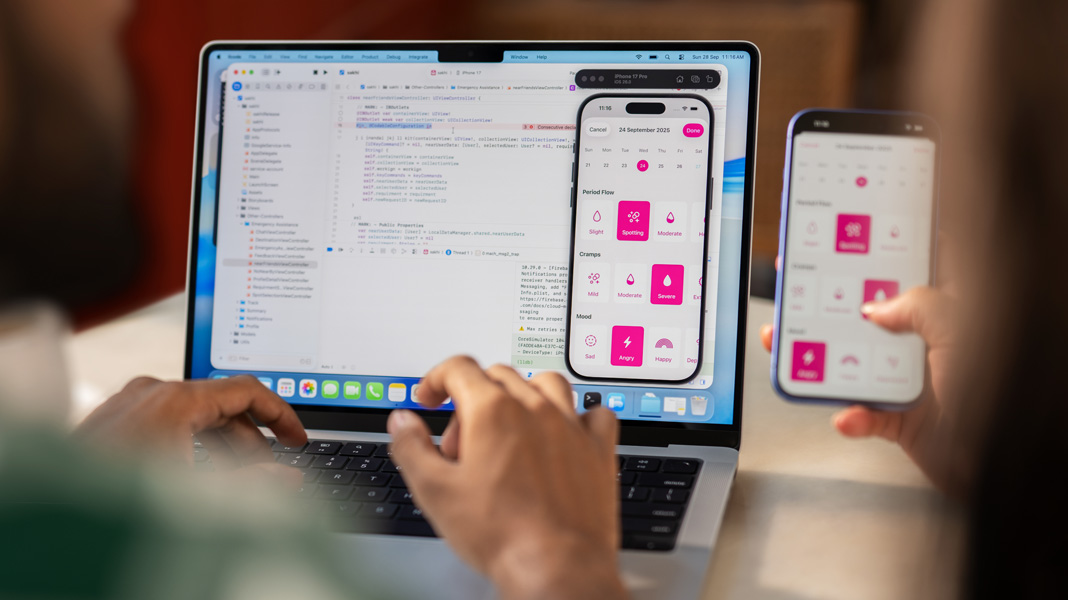
Sakhi, a Hindi word for a trusted female friend, was shaped by cultural context as much as code. When someone is far from home or caught without menstrual supplies, the app lets them discreetly request support from nearby users in real time. It also provides health guidance and emotional check-ins—all with privacy in mind. Optional cycle tracking is included, but is not the app’s defining purpose.
“The goal was never to make another period tracker,” Karan explains. “I wanted Sakhi to feel like a trustworthy companion, something users could turn to when they needed help.”
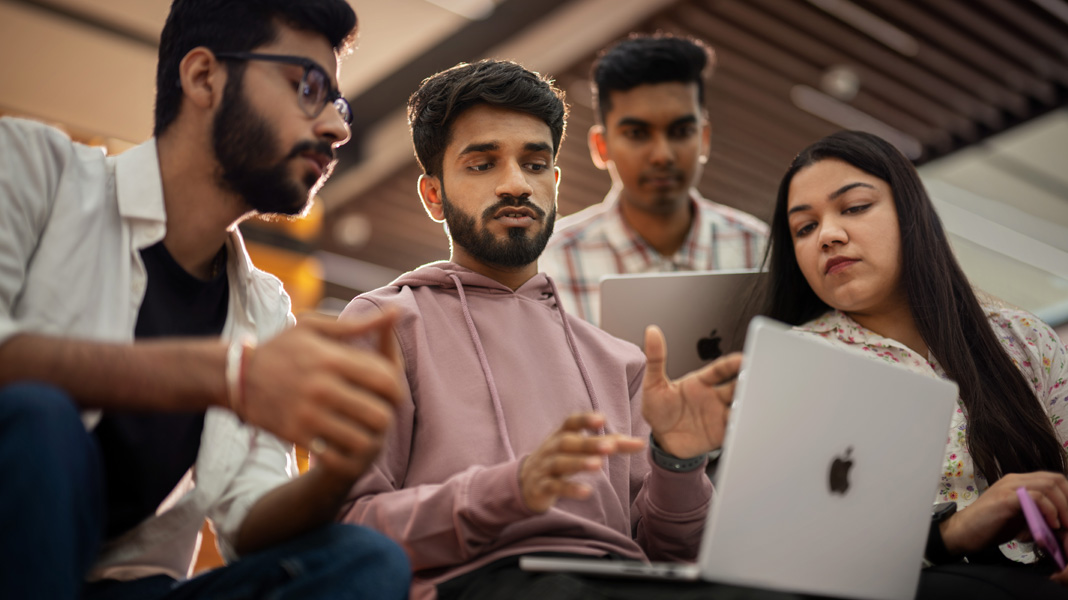
Following a competitive selection process, students participated in a five-day iOS bootcamp. There, Kumar met fellow student Arpita Gupta and began refining Sakhi’s problem statement: reducing stigma around menstrual health by creating a discreet digital space where women could ask for help and get support without judgment.
Kumar built his answer to the problem in the iOS Student Developer Program using Apple’s learning resources and devices, with support from Infosys. There, students learn through an active, project-based approach rather than traditional methodologies. They gain hands-on experience with Apple’s suite of developer tools and design resources, which challenges them to clearly identify a problem, understand cultural nuance, and articulate who they are designing for — all before ever writing a line of code. For Kumar, the process was essential in translating a deeply personal motivation into a focused, viable product.
Karan took on the role of team lead, focusing on UI and UX design as well as iOS development. Arpita contributed early user research and health-related insights, helping the team look past the code to understand the human needs of the women who would actually use the app.
As development progressed, they realized more perspectives were needed beyond engineering. Input from medical professionals, user testing, and ongoing feedback played a key role in defining the app’s functionality and flow. The process reinforced the importance of collaboration and listening closely to feedback throughout development.
The app’s features are designed to help users navigate sensitive moments with discretion and control. With personal health information involved, Karan and the team prioritized privacy, security, and intelligent design right from the start. To meet that standard, they turned to Apple.

Apple developer tools have a strong focus on quality, privacy, and security. We choose iOS because it gives us a more stable environment to build these priority features.
The iOS Student Developer Program provided the structure, tools, and mentorship needed to take an ambitious idea and make it a reality. Using Swift and Xcode, the students moved Sakhi from concept to a working app, launching it in the App Store shortly after graduating from the program. Within days, it saw early adoption and continued to evolve as its users and use cases grew.
For Kumar, the most meaningful outcome of the program wasn’t being published on the App Store, but the responsibility it carried. Sakhi became something people could turn to in moments of vulnerability, tying his work directly to the needs that first inspired him.
The app stands as an example of what the iOS Student Developer Program was designed to do: give passionate, driven students the opportunity to identify real problems and build solutions grounded in the world they live in. “The program helped me grow, not just as a developer, but as a designer,” he says. “I learned how important it is to listen to feedback and build with intention.”
Today, Karan works as an iOS Developer, applying the same approach to problem-solving — with empathy and respect for the people on the other side of the screen.
The iOS Student Developer Program is championing many other passionate students at universities across India. Read the story